
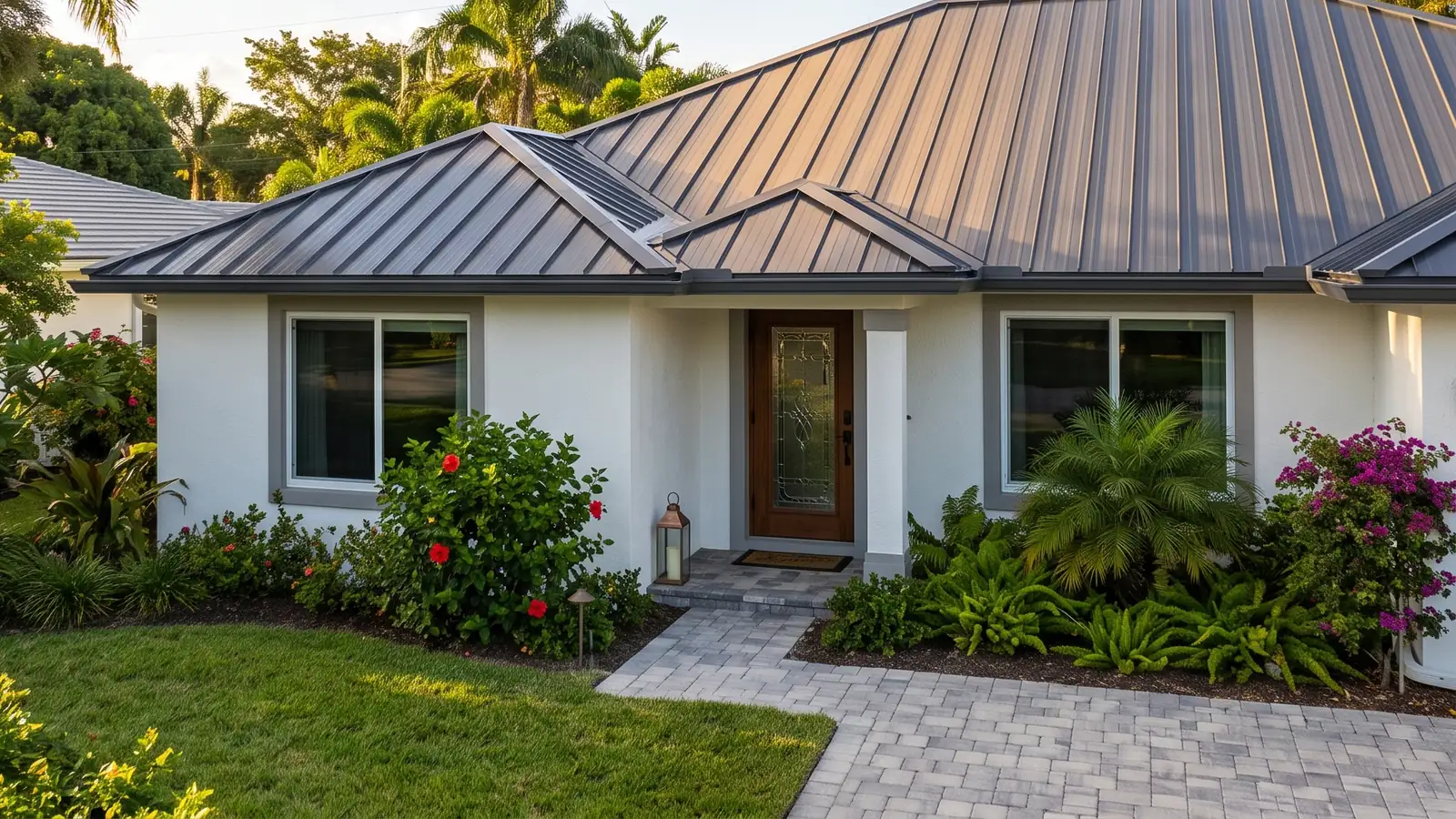
Standing Seam Metal Roof Types
Every standing seam roof hides its fasteners under the seam. What separates the types is how that seam is closed, what the panel is made of, and how wide and flat it is.
Mechanically Seamed Standing Seam
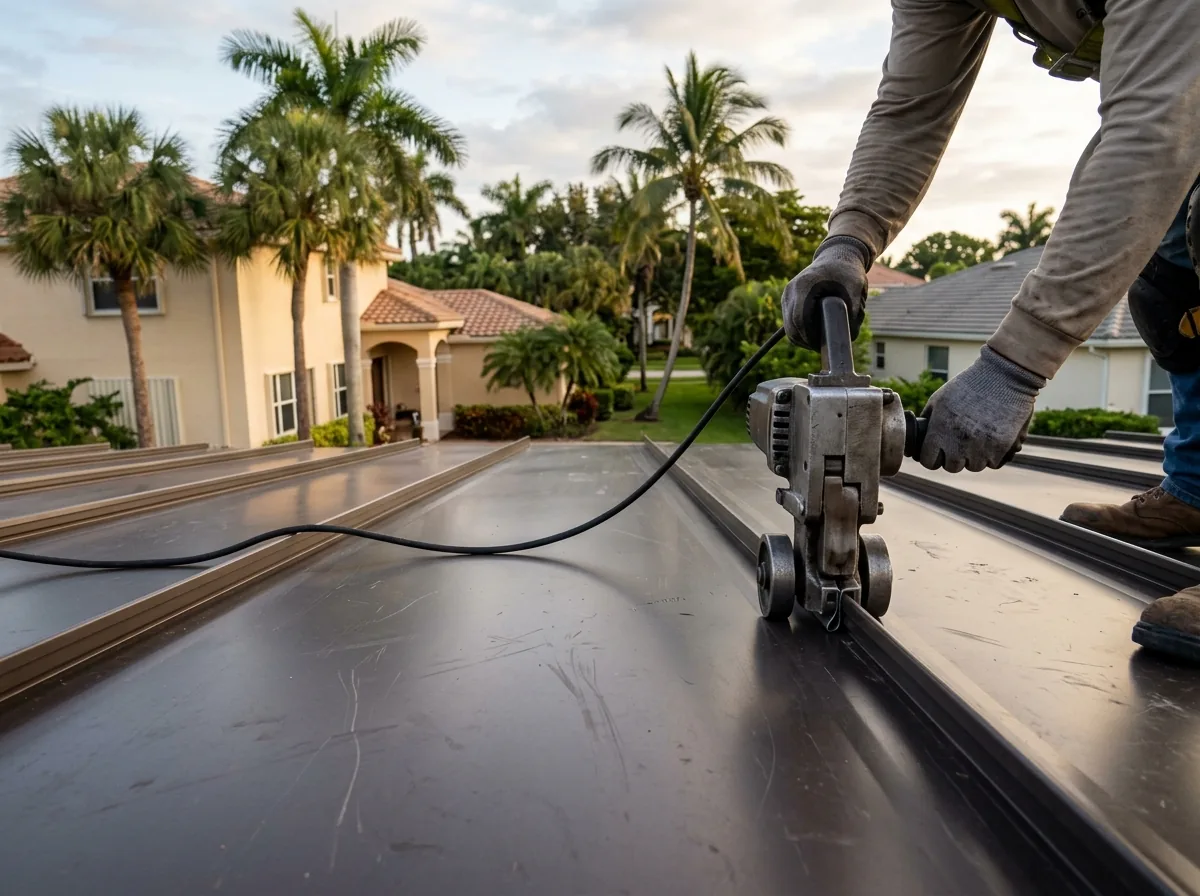
On a mechanically seamed roof, each panel's female leg goes over the neighbor's male leg and a seaming machine rolls along the joint, folding the metal over itself. One fold of 90 degrees is a single lock. Keep going to 180 degrees and you have a double lock, which traps the clip tab inside the seam and is very hard for wind to pull apart.
We'd point most Hollywood homeowners toward a mechanically seamed panel, and the approvals show why. One current Miami-Dade approval for a 1.5-inch aluminum panel requires a double-lock (180°) seam and a bead of sealant along the rib before the next panel goes on. The approval also allows that panel down to a 1:12 slope because it passed the ASTM E2140 water leakage test. The catch is labor: seaming takes a machine and a crew that knows how to run it, so expect a higher quote than snap-lock.
Snap-Lock Standing Seam
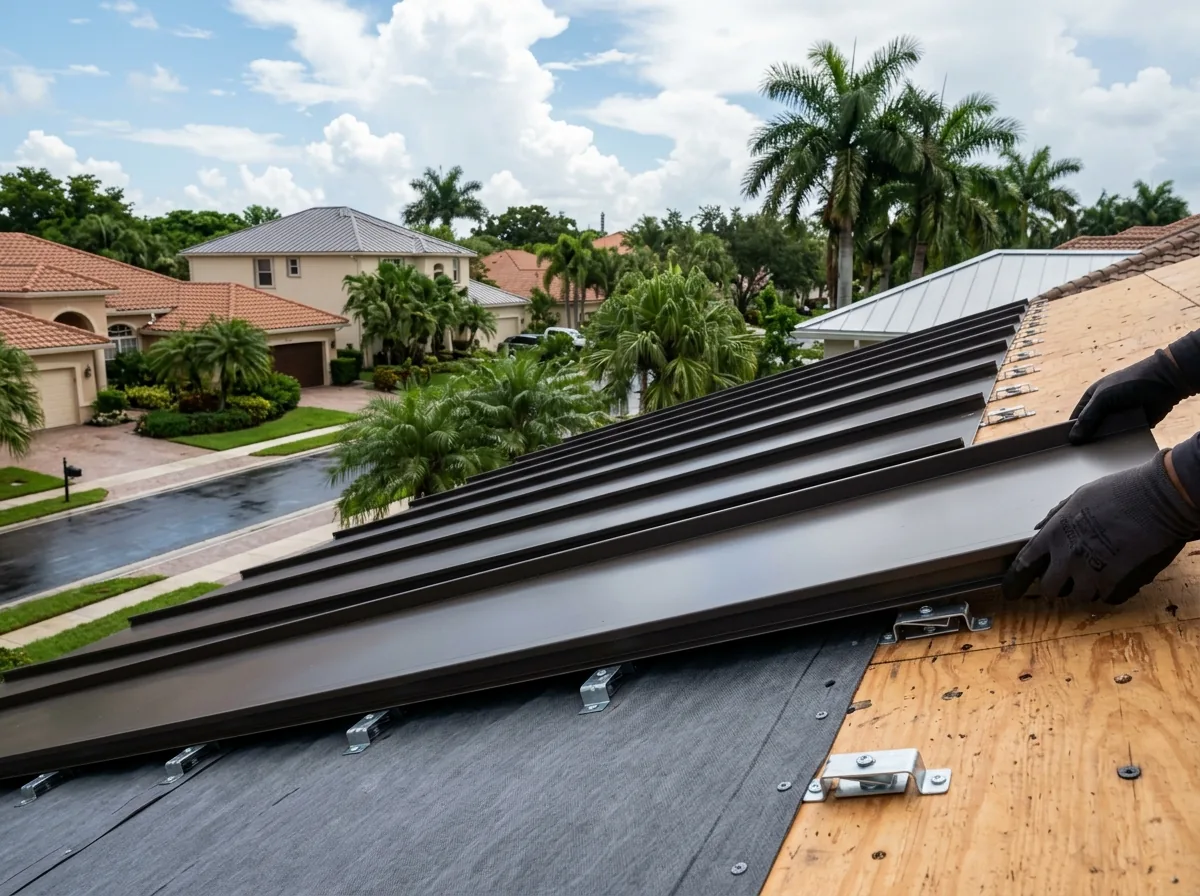
Snap-lock panels have legs shaped to click together under hand or foot pressure. No seamer, less labor, a lower price. Clips still hold the panel to the deck, screwed through their base into the plywood, and the next panel snaps over them.
A cheaper cousin, the nail-strip panel, skips the clips and fastens through slotted holes along one edge. Nail it too tight and the panel can't move with heat, which causes premature wear. Snap-lock is also generally less secure than a mechanically locked seam in high wind. It isn't banned here, but read the fine print on the approval. The snap-lock approval we checked, for a 24-gauge steel panel, only covers roofs of 4:12 or steeper.
Steel vs Aluminum Standing Seam
Steel standing seam is Galvalume or G-90 coated and runs 24 or 26 gauge on houses, with 24 the stiffer choice. It costs less than aluminum and resists dents better. Aluminum doesn't form red rust, so it's the safer pick on the barrier island and along the Intracoastal, where at least one major maker's coated-steel warranty stops covering the panel. Aluminum dents more easily and costs more.
A good rule: if you can smell the ocean from the driveway, price aluminum before you decide. See aluminum roofing.
Panel Width, Striations and Oil Canning
Panels run about 12 to 24 inches wide. Wider panels mean fewer seams and a lower price, but more flat metal between ribs, and flat metal shows oil canning: a wavy look that appears in low sun. It's cosmetic. Some owners never notice it and some can't stop seeing it.
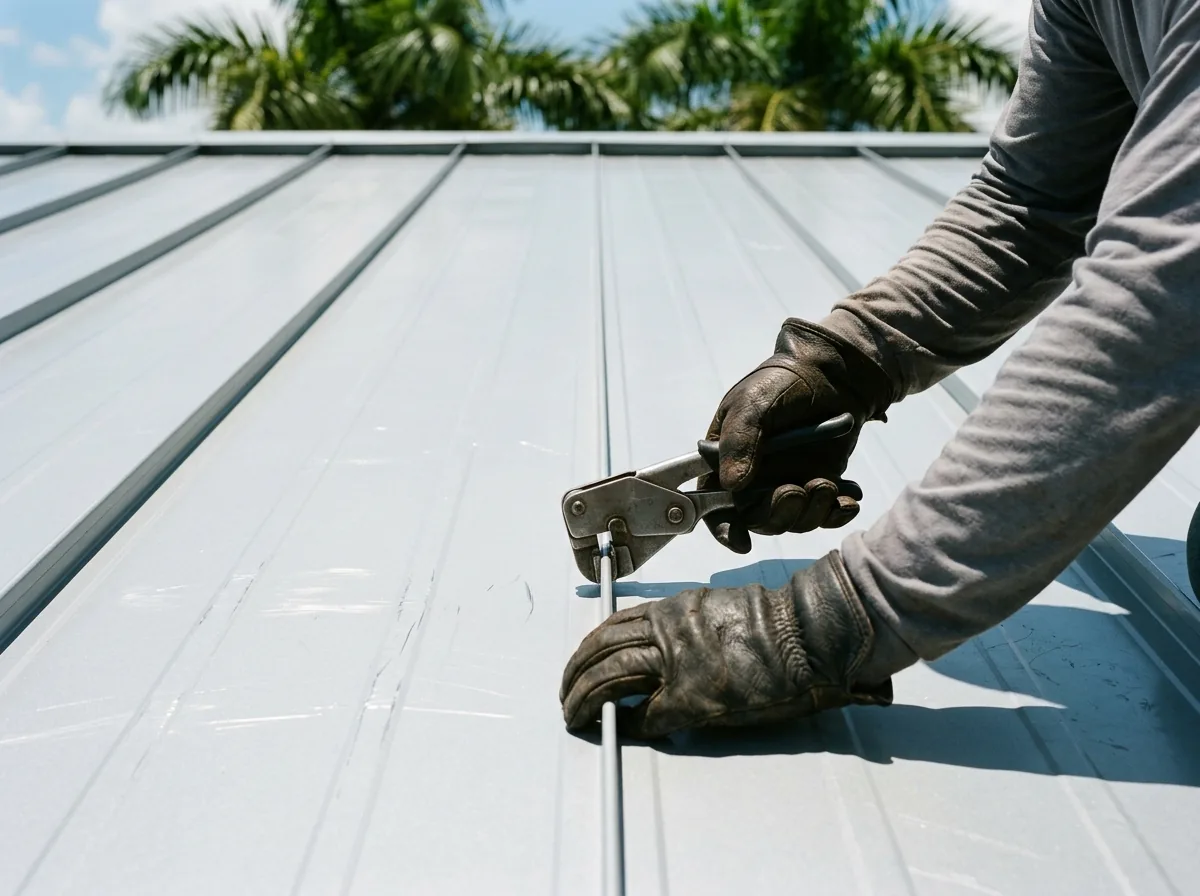
Narrower panels, thicker gauge, striations (shallow ribs pressed into the flat), a lighter color and a flat, true deck all reduce it. On a street-facing roof, we'd take a 16-inch striated panel over a 24-inch flat one.
Why Hollywood homeowners call Hollywood Metal Roofing
- Free written estimate
- Panel, gauge and product approval listed in writing
- City of Hollywood permit and inspections
- One local metal roofing contractor, not a call list
- No charge to homeowners for the referral
Standing Seam Metal Roof Cost
HomeGuide gives national figures. A typical standing seam job comes to $13,500 to $40,000, or $9 to $16 per square foot installed. Split by metal, steel runs $8 to $13 a square foot and aluminum $9.50 to $17 (HomeGuide). No source we trust publishes a Hollywood-only range, so treat these as a starting point and the written quote as the real number.
What moves a standing seam quote:
Seam type
Double-lock costs more in labor than snap-lock.Metal and gauge
Aluminum is the pricier metal, and 24 gauge steel costs more than 26.Panel width and striations
Narrow panels mean more panels and more seams.Roof shape
Standing seam needs more trim than screw-down panels, and every hip, valley and wall adds some.Clip spacing
Tighter spacing at corners and edges means more clips and more time, and the approval sets it.Tear-off and deck
Tile or two layers of shingles take longer to remove, and soft plywood gets replaced before panels go on.
Panels are made to order in a factory or rolled on site from coil. Site roll-forming lets a single panel run from eave to ridge on a long roof, so no end laps.
Standing Seam Finishes and Colors
Most standing seam panels carry a PVDF finish, often sold under the Kynar 500 or Hylar 5000 names. Kynar 500 coatings are made by licensed paint manufacturers, and Arkema says these finishes meet the AAMA 2605 standard for architectural coatings. The finish is what fights chalking and fading under South Florida sun, so ask the contractor to write the paint system on the quote, not only the color name. Custom colors cost extra.
For heat, compare colors on the Cool Roof Rating Council directory. It lists solar reflectance and thermal emittance for rated products, both when new and after three years of outdoor weathering. The three-year figure is the one to compare, because every finish loses some reflectance to dirt and weather. A pale gray with a high aged reflectance will keep the attic cooler than a dark bronze.
Standing Seam in the High-Velocity Hurricane Zone
Hollywood is in Broward County, and Broward is part of Florida's High-Velocity Hurricane Zone. Section 1518.9 of the Florida Building Code sets the floor: steel panels G-90 coated and at least 26 gage, aluminum at least 0.025 inch, and a product approval covering the complete system. The approval is where standing seam gets specific. It names the panel, the clip, the screws, the underlayment, the deck thickness and the clip spacing.
Clip spacing tightens at the edges, where wind pulls hardest. The double-lock aluminum approval mentioned above allows clips at 12 inches in the field and 6 inches at the perimeter and corners. The snap-lock steel approval allows 16 and 8. Each approval also lists a maximum design pressure, and those two differ a lot: 181 psf for the double-lock aluminum at perimeters and corners, 101 psf for the snap-lock steel. The contractor's permit drawings show what your roof needs, so check that the system on the quote meets it.
Slope matters too. Outside the HVHZ, section 1507.4.2 allows standing seam down to 1/4:12 while lapped, unsealed panels need 3:12. Inside the HVHZ, Table 1515.2 sets architectural metal panels at 2:12, with standing seam allowed to 1:12 only if the system passed ASTM E2140. For a low-pitch porch or addition, that test result is the thing to ask about.
A few things to check on the quote:
Approval number
Look it up and confirm it hasn't expired.Seam
Snap-lock, single lock or double lock, in writing.Clip spacing
Field and perimeter figures, matching the approval.Clips and screws
Stainless or otherwise compatible with the panel metal.Labels
HVHZ-approved panels and clips carry the manufacturer's permanent label.